How Andrew Lauren Interiors Went From Hours of 3D Modeling to 30-Second Renders
How Andrew Lauren Interiors Went From Hours of 3D Modeling to 30-Second Renders
A high-end interior design firm replaced its entire 3D rendering pipeline with AI-powered visualization and cut design turnaround to a fraction of what it was.
A high-end interior design firm replaced its entire 3D rendering pipeline with AI-powered visualization and cut design turnaround to a fraction of what it was.
30-Second Renders
From smartphone photo to fully rendered, high-quality visual in 30 seconds. No 3D modeling required.
Zero 3D Software Needed
Designers upload a 2D photo, select materials from the catalog, and generate. No modeling skills required.
Scalable Design Templates
Successful concepts saved as reusable templates. Any designer on the team can apply them to new projects instantly.
30-Second Renders
From smartphone photo to fully rendered, high-quality visual in 30 seconds. No 3D modeling required.
Zero 3D Software Needed
Designers upload a 2D photo, select materials from the catalog, and generate. No modeling skills required.
Scalable Design Templates
Successful concepts saved as reusable templates. Any designer on the team can apply them to new projects instantly.
THE CHALLENGE
Hours of 3D Modeling Just to Show a Client What It Could Look Like
Andrew Lauren Interiors is a high-end interior design firm where delivering polished design concepts is the core of the client experience. But producing those concepts traditionally required hours of intensive 3D modeling, creating a bottleneck that drove up rendering costs, extended timelines, and limited how many iterations a designer could realistically offer.
Holly Isom, Director of Estimating & Special Projects, saw the problem clearly. Every project pulls materials and products from different manufacturers, most of which lack usable visual tools. That left designers with two options: build a full 3D render from scratch or physically take clients to a showroom. Neither scales.
The time cost was the real pain point. As Holly put it, the amount of time designers spent just trying to show a client what something would look like was enormous. Hours of software work for a single concept that might get rejected in the first meeting. The goal was simple: get a realistic visual in front of the client faster, without sacrificing quality.
THE CHALLENGE
Hours of 3D Modeling Just to Show a Client What It Could Look Like
Andrew Lauren Interiors is a high-end interior design firm where delivering polished design concepts is the core of the client experience. But producing those concepts traditionally required hours of intensive 3D modeling, creating a bottleneck that drove up rendering costs, extended timelines, and limited how many iterations a designer could realistically offer.
Holly Isom, Director of Estimating & Special Projects, saw the problem clearly. Every project pulls materials and products from different manufacturers, most of which lack usable visual tools. That left designers with two options: build a full 3D render from scratch or physically take clients to a showroom. Neither scales.
The time cost was the real pain point. As Holly put it, the amount of time designers spent just trying to show a client what something would look like was enormous. Hours of software work for a single concept that might get rejected in the first meeting. The goal was simple: get a realistic visual in front of the client faster, without sacrificing quality.
A Visualization Tool That Skips the 3D Pipeline Entirely
Andrew Lauren Interiors implemented a custom-built AI visualization tool from Renovate AI that completely bypasses traditional 3D modeling.
The workflow is radically simpler than what it replaced. Designers upload a standard 2D room photo taken on a smartphone. They select materials directly from an integrated product catalog. They type specific stylistic requirements into a chat field. The tool generates a photorealistic rendering.
No 3D software. No modeling skills. No render queue. The entire process from photo upload to finished visual takes 30 seconds.
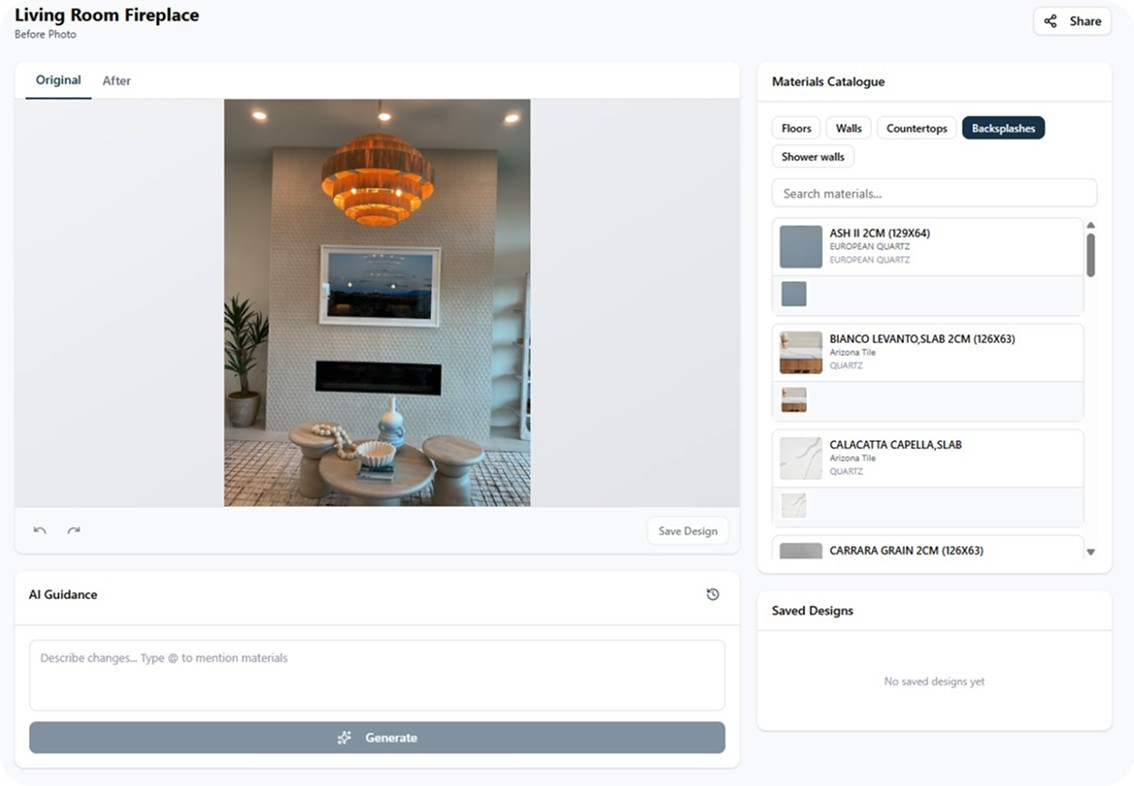
Andrew Lauren designers generate photorealistic concepts directly from smartphone photos using the Renovate AI design tool.
A Visualization Tool That Skips the 3D Pipeline Entirely
Andrew Lauren Interiors implemented a custom-built AI visualization tool from Renovate AI that completely bypasses traditional 3D modeling.
The workflow is radically simpler than what it replaced. Designers upload a standard 2D room photo taken on a smartphone. They select materials directly from an integrated product catalog. They type specific stylistic requirements into a chat field. The tool generates a photorealistic rendering.
No 3D software. No modeling skills. No render queue. The entire process from photo upload to finished visual takes 30 seconds.
Andrew Lauren designers generate photorealistic concepts directly from smartphone photos using the Renovate AI design tool.
The amount of time that it's taking for them to go through this process just to show them what it looks like is a lot of time.
— Holly Isom, Director of Estimating & Special Projects, Andrew Lauren Interiors
THE INSIGHT
Designers Needed Guardrails, Not an Open Canva
The rollout revealed something unexpected about how designers adapt to AI tools. Holly discovered that her team was so accustomed to legacy software, where every action is deterministic and constrained, that the open-ended nature of AI prompting actually created friction. Designers were used to clicking a tile and getting exactly one predictable result. An AI tool that could interpret freeform instructions felt unfamiliar, not liberating.
The insight was critical: more flexibility doesn't automatically mean better adoption. Designers needed guided workflows and structured inputs, not a blank prompt field. Without that structure, the power of the tool became a source of frustration rather than speed.
The amount of time that it's taking for them to go through this process just to show them what it looks like is a lot of time.
— Holly Isom, Director of Estimating & Special Projects, Andrew Lauren Interiors
THE INSIGHT
Designers Needed Guardrails, Not an Open Canva
The rollout revealed something unexpected about how designers adapt to AI tools. Holly discovered that her team was so accustomed to legacy software, where every action is deterministic and constrained, that the open-ended nature of AI prompting actually created friction. Designers were used to clicking a tile and getting exactly one predictable result. An AI tool that could interpret freeform instructions felt unfamiliar, not liberating.
The insight was critical: more flexibility doesn't automatically mean better adoption. Designers needed guided workflows and structured inputs, not a blank prompt field. Without that structure, the power of the tool became a source of frustration rather than speed.
From Learning Curve to Company-Wide Rollout
Holly's solution was to build the structure into the tool itself. She created a library of Design Templates: pre-built aesthetic concepts that had already been validated with clients.
Instead of asking every designer to learn prompt engineering, she packaged successful designs into reusable starting points. Any designer on the team can now select a template, apply it to a new client's space, and generate a polished concept without starting from zero. The results across the firm: Rendering costs: Dramatically reduced. No more paying for hours of 3D modeling per concept. Design turnaround: From hours of rendering to 30 seconds per visual. Designers present more options in less time. Team scalability: Junior designers produce agency-quality visuals using templates built by senior designers. The quality bar stays consistent without bottlenecking senior staff. Client experience: Clients see realistic representations of their space in the first meeting, not weeks later. Faster decisions, fewer revision cycles. The template approach turned individual designer expertise into a company-wide asset. One great design concept, once validated, becomes available to every designer on the team instantly.
From Learning Curve to Company-Wide Rollout
Holly's solution was to build the structure into the tool itself. She created a library of Design Templates: pre-built aesthetic concepts that had already been validated with clients.
Instead of asking every designer to learn prompt engineering, she packaged successful designs into reusable starting points. Any designer on the team can now select a template, apply it to a new client's space, and generate a polished concept without starting from zero. The results across the firm: Rendering costs: Dramatically reduced. No more paying for hours of 3D modeling per concept. Design turnaround: From hours of rendering to 30 seconds per visual. Designers present more options in less time. Team scalability: Junior designers produce agency-quality visuals using templates built by senior designers. The quality bar stays consistent without bottlenecking senior staff. Client experience: Clients see realistic representations of their space in the first meeting, not weeks later. Faster decisions, fewer revision cycles. The template approach turned individual designer expertise into a company-wide asset. One great design concept, once validated, becomes available to every designer on the team instantly.
See What Your Design Workflow Could Look Like
Book a 30-minute walkthrough with our enterprise team.
Or reach us at [email protected]
See What Your Design Workflow Could Look Like
Book a 30-minute walkthrough with our enterprise team.
Or reach us at [email protected]
Schedule a call
Schedule a call
Designed and built with love • All rights reserved Trial and Error, Inc | Copyright© 2024